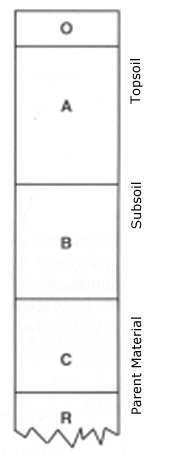
Very shallow soils have less than 10 inches of soil that
can be penetrated by plant roots.
Soil Slope
Slope has a tremendous effect on water runoff, erosion, and use of
farm machinery. It is expressed as a percent, and is defined as the number
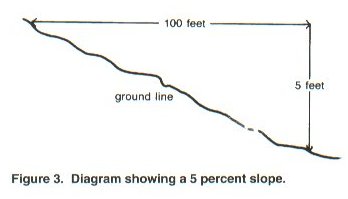
of feet that the land rises or falls in a 100-foot horizontal distance.
For example, a slope between two points which are 100 feet apart with a
difference in elevation of 5 feet would have a 5% slope (Figure 3). Six
slope classes are recognized in Oklahoma land judging.
Nearly level --- Land with less that 1 foot elevation
change in 100 feet.
Gently sloping --- Land with 1 to 3 feet elevation change
in 100 feet.
Moderately sloping --- Land with 3 to 5 feet elevation
change in 100 feet.
Strongly sloping --- Land with 5 to 8 feet elevation change
in 100 feet.
Steep --- Land with 8 to 15 feet elevation change in 100
feet.
Very Steep --- Land with over 15 feet elevation change
in 100 feet.
Erosion
Soil erosion is the detachment and movement of soil materials by wind
or water. Erosion consists of three distinct processes -- detachment, transport,
and deposition. Raindrops falling on unprotected soil, wind striking unprotected
soil particles, and the bombarding action of moving particles are detachment
forces. Flowing water and air currents are the transportation forces. Four
erosion classes are recognized in land judging.
None to slight --- Soils of this class show no obvious
effect of erosion. The plow layer exhibits characteristics of the "A" horizon.
Less than 25 percent of the surface soil has been removed and no gullies
are present.
Moderate --- Soils of this class have 25 to 75 percent
of the original surface layer present. The plow layer may consist of a
mixture of the surface "A" horizon and underlying "B" horizon. Small rills
and occasional, crossable gullies may be present. It may or may not change
the land capability class but it is always considered a factor to keep
an area out of Class I.
Severe --- Soils of this class have been eroded to the
extent that over 75 percent of the original surface layer is removed. The
plow layer exhibits characteristics predominately of "B" horizon. Frequent
crossable gullies, or occasional uncrossable gullies, or occasional wind
blow-out area may be present.
Very severe --- Soils of this class have over 75 percent
of surface soil removed with frequent uncrossable gullies and/or severe
accumulations by wind. The plow layer exhibits characteristics similar
to severely eroded soils. If wind is the main erosion force, blow-outs
are numerous and deep. In either case, areas are unfit for crop production
without extensive reclamation.