
This contest is designed to emphasize the
importance of soils and their limitations for homesites. The importance
of a soil's suitability for parks, playgrounds, roads, streets,
and other uses can also be considered. Many of the properties important
for agricultural uses are also important for urban uses. While the
properties are the same, a different set of criteria is used to evaluate
urban uses.
Defining Limitations
Soils have limitations in use depending on
their inherent properties. In homesite evaluations, the soils are
rated as having slight, moderate, severe, or very severe limitations as
follows:
Slight limitations -- Soils
or sites have properties favorable for the planned use and present few
or no problems. Low maintenance can be expected.
Moderate limitations -- Soils
or sites have one or more properties considered somewhat restrictive for
the planned use. Limitations may be overcome or modified with special
planning, design, treatment, or maintenance.
Severe limitations -- Soils
or sites have one or more properties unfavorable for the planned use.
Limitations are very difficult and expensive to modify or overcome for
the desired use. A severe rating means that extensive, costly work
needs to be done to overcome the soil limitations for the use desired.
Very severe limitations --
Soils or sites have features so unfavorable for a particular use that overcoming
the limitations is very difficult and extremely expensive and
generally should not be used for the purpose being rated.
Defining Land Uses
Factors Affecting Suitability
Permeability
Limitation ratings will be made for four homesite
uses: (1) foundations for buildings, (2) lawns and landscaping, (3)
septic system absorption field, and (4) sewage lagoon. Ratings for
other uses can be made but are not included in this contest.
Foundations for buildings --
This determination reflects the suitability of the soil to support buildings.
Some important soil properties that affect building foundations are soil
depth, slope, shrink-swell potential, water table, and flooding.
Lawns and landscape plantings
-- This rating reflects the use of the soil for growing lawns, shrubs,
trees, and vegetable gardens. The important soil properties are those
that affect establishment and maintenance of planting. They include
texture, permeability, soil depth, runoff, water table, plant response
when fertilizer is applied, and absence of toxic materials such as salts.
Septic tank absorption field
-- Subsurface systems of tile or perforated pipe that distribute waste
water (effluent) from a septic tank into the soil for purfication.
Properties and features that affect the absorption of the effluent are
permeability, water table, soil depth, and flooding. Stones and shallow
depth may interfere with installation and excessive slope can affect the
operation of the system.
Sewage lagoon -- A dug pond used to
hold sewage solids for bacterial decomposition and effluent evaporation
is a sewage lagoon. Consideration of the soils ability to impound
water and for use as embankment material must be made. Soil properties
affecting sewage lagoons are soil texture, permeability, soil depth, water
table, slope, and flooding.
Texture
This refers to the texture of the surface
soil. Surface texture is not a factor for septic systems and sewage
lagoons because lagoons and lateral lines are dug below the surface.
Coarse: Moderate limitations for
all uses -- May require stabilization with organic material and/or
loamy topsoil to improve moisture and nutrient holding and supplying capacity
for desired plant growth. Water and wind erosion may be a problem
during construction.
Moderately Coarse, Medium, Moderately
Fine: None to slight limitations for all uses -- Care should be
exercised during construction to be sure the surface soil is not covered
by less desirable material.
Fine: Severe limitations for all
uses, except none to slight limitations -- For sewage lagoons.
Soil is sticky when wet, hard when dry, and difficult to work with in flower
beds and gardens. The soils crack when dry, swell when wet, requiring
frequent and low rate of watering for plant growth.
This refers to the rate water or air moves
through the most restricted layer in the soil. This may be considered
as internal drainage. Laterals for septic systems may be located
below such layers in some soils. Final design should be based on detailed
study of permeability, seasonally high water tables, and a standard percolation
test to determine infiltration rates where soils are slow or very slowly
permeable. These investigations are important factors in deciding
between septic tank absorption fields, sewage lagoons, or a community sewage
system. Generally, soils unsuited for septic systems are much better
suited for lagoons. For septic systems, evaluate the permeability
of soil layers below 30 inches and for sewage lagoons evaluate the layers
between 12 to 60 inches.
| Special note: For contest purposes, permeability will be determined from the subsoil texture box. |
Rapid: Slight limitations
for
septic system absorption field. Moderate limitations for lawns
and landscape planting. Severe limitations for sewage lagoons.
The soils are coarse textured. Permeability is more than 2 inches
per hour. If the permeability is greater than 6 inches per hour,
seepage from lagoons will occur and make it difficult to maintain adequate
water depth and could contribute to ground water pollution. Septic
systems may not adequately filter waste water. When the permeability
is greater than 6 inches per hour, it is considered a very severe limitation
for both septic systems and lagoons.
Moderate: Moderate limitations
for
septic system absorption field and sewage lagoons. The soils are
moderately coarse and medium textured with weak prismatic to blocky and
strong granular structure. Permeability ranges from 0.6 to 2 inches
per hour. None to slight limitations for lawns and landscape
plantings.
Slow: Severe limitations for
septic system absorption field. Soils are generally moderately fine
textured with a subangular blocky structure. Problems are generally
similar to the very slowly permeable soils but the modifications required
for use are less intense. Permeability ranges from 0.06 to 0.6 inches
per hour. Percolation tests should be run to design a suitable septic
tank disposal field. At the .06 inch per hour rate (1 1/2 inches
per day), the cost of modifications and size of filter field would be prohibitive.
Limitations would be none to slight for sewage lagoons and moderate for
lawns and landscape plantings.
Very Slow: Very severe limitations
for septic system absorption field. Permeability is less than 0.06
inches per hour. This would require a prohibitively large field of
laterals or costly modifications would be necessary to effectively dispose
of the effluent. Septic systems are generally not recommended.
None to slight limitations for sewage lagoons. Subsoils are
fine textured and break into sharp angular blocks or clods that are plastic
and sticky when wet and very hard when dry. The clods are usually
coated with clay which restricts water movement. Severe limitations
for lawns and landscape plantings.
Soil Depth
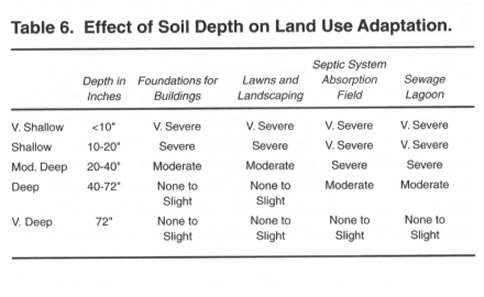
This refers to the vertical depth of a soil
to bedrock such as sandstone, limestone, or consolidated clays that restrict
roots and excavations. Severity of limitations because of depth vary
greatly for different uses. Table 6 is a guide for evaluation of
soil depth for homesite uses.
Slopes
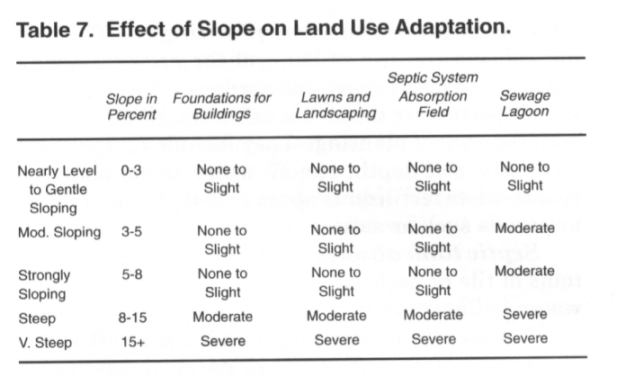
This refers to the steepness of the surface
or the vertical rise or fall over 100 feet of distance, expressed in percent.
Broader and different slope ranges apply to homesite use considerations
than normally apply to considerations for agricultural uses. Table
7 will aid in interpretation of the slope condition for homesite evaluation.
Erosion
Erosion of the soil can increase the expense
of landscaping and require additional topsoil to be brought onto the site.
Severe gullies will impose additional limitations on septic system absorption
fields.
None to Slight and Moderate: None
to slight limitations for any use.
Severe: Moderate limitations
for any use.
Very Severe: Severe limitations
for any use. Usually severely gullied areas require much filling
and leveling, extra expense on septic system absorption field, and extensive
modification for flower beds, lawns, etc.
Surface Runoff
This is generally a factor of importance in
connection with drainage, permeability, and erosion. Special attention
needs to be given to surrounding areas. Runoff from adjacent areas
onto building sites and the possibility of ponding water around the building
foundation need consideration. Surface runoff is not a factor for
sewage lagoons because they will be protected from outside water.
Rapid: Occurs on slopes
above 5% except on deep sands where runoff would be slow. Severe
limitations requiring care to maintain and to prevent erosion on lawns
and gardens. None to slight limitations for foundation for buildings
and septic systems absorption field.
Moderate: None to slight limitations
for foundations and septic systems. Moderate limitations for lawns and
landscape plantings. Occurs on slopes of 3% to 5%.
Slow: Occurs on nearly level to very gently sloping areas (0 to 3%) and deep sands. Moderate limitations may require modification for building foundations and special design of septic system absorption field. On deep sands, slow runoff would not present any limitations. None to slight limitations for other uses.
Shrink-Swell
This factor is implied in the permeability,
texture, and mineralogy of a soil. Because it is important in foundation
design, it should have special consideration. The most clayey layer
in the profile is generally considered in shrink-swell limitations.
Shrink-swell is not generally a factor for lawns and landscape plantings.
Low: Coarse and moderately
coarse textured soils have none to slight limitations for all uses.
Moderate: Medium and moderately
fine textured soils have moderate limitations for all uses, except none
to slight for sewage lagoons.
High: Fine textured soils
have severe limitations for all uses, except none to slight for sewage
lagoons.
Water Table
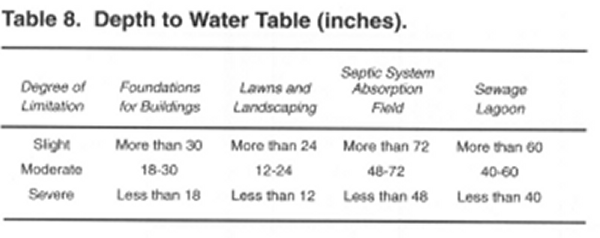
The internal wetness of an area is influenced
by most of the factors previously discussed. Generally, internal
drainage is a reflection of permeability. However, the presence and
depth to a water table is more a reflection of climate, season, and landscape
position. It must be evaluated on the basis of depth to the seasonal
high level and the permanency of the water table. This requires study
during different times of the year and under differing climatic conditions.
|
For contest purposes, water table depth will be given information. A water table is:
|
Flooding
The occurrence of floods is a factor frequently overlooked in
planning the use and management of land. Flooding may not occur on
an area for many years, then a serious flood can occur. Urban development
on the watershed of a small stream can increase runoff up to 75%, thus
greatly increasing the flood hazards. Soils may give an indication
of flooding, but records must be studied to determine the true condition.
Position in the landscape and proximity to nearby streams are good indicators
of frequency of flooding. In contests this is normally given information.
Conducting Homesite Evaluation
Homesite evaluation contests are conducted in the same manner
as land judging. Additional items must be added to the given information
site card. The contestant should be given 15 minutes to fill out
a scorecard. If both land and homesite evaluation are judged simultaneously,
a combined time of 20 to 25 minutes is ample.
To avoid having the contest become too long and the grading burdensome
by adding homesite evaluation, several alternatives are possible.